Research
Single-ion error correction
DeBry, Valdes Martinez, Meister, McConnell, Bruzewicz, Chuang, Chiaverini
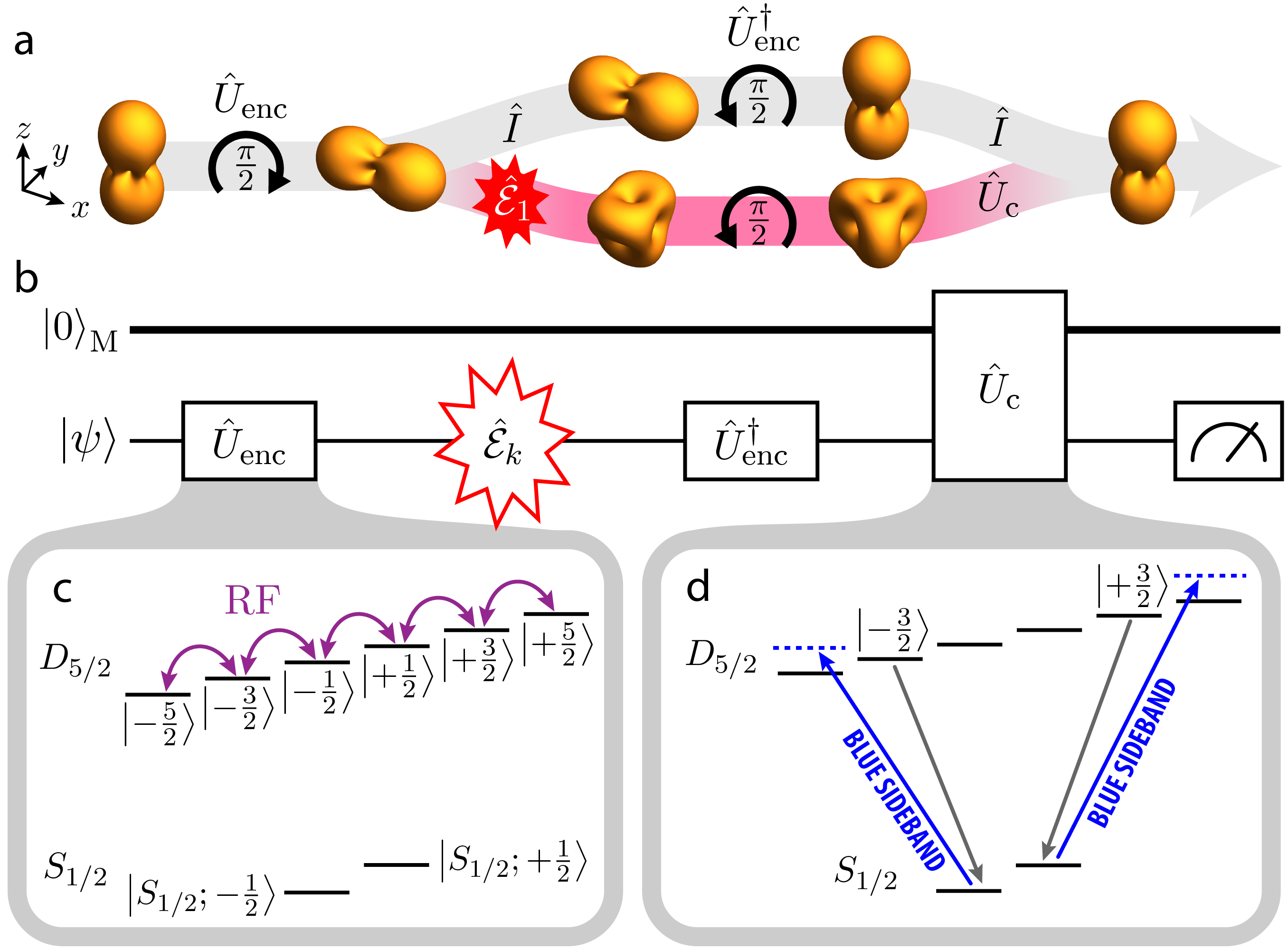
I led an experiment demonstrating quantum error correction within a single 40Ca+ ion by encoding a logical qubit in the six-level spin-5/2 manifold using spin-cat codewords. A measurement-free (autonomous) recovery uses the ion’s motional mode as a resettable ancilla, correcting dephasing errors: logical error is reduced by up to 2.2× and the useful coherence time is extended by up to 1.5× relative to an unencoded qubit.
This work represents the first demonstration of qudit-based quantum error correction in a single particle. Using high-fidelity operations in the D5/2 manifold together with spin-motion coupling, we implement encoding, decoding, and autonomous correction without requiring mid-circuit measurements. The approach provides hardware-efficient protection against the dominant dephasing mechanism and opens the door to more tailored error correction codes to be used in a variety of applications.

Logical operations on single-ion logical qubits
DeBry, Valdes Martinez, Plocki, McConnell, Bruzewicz, Chiaverini, Chuang
We have developed and demonstrated a novel entangling gate for multi-level qudits using metastable states of trapped 40Ca+ ions, enabling logical operations on single-ion logical qubits encoded in the six-level D5/2 manifold. These operations can also be used to create a maximally-entangled two-qudit state for qudit processing and quantum simulation experiments.
We combine this logical entangling interaction with logical single-qubit rotations to implement a universal set of logical gates. See above for more information on single-ion logical qubits.
Preprint coming soon
Real-time noise tracking and feedforward with monitor ions
DeBry, Valdes Martinez, Reens, Bruzewicz, Chiaverini
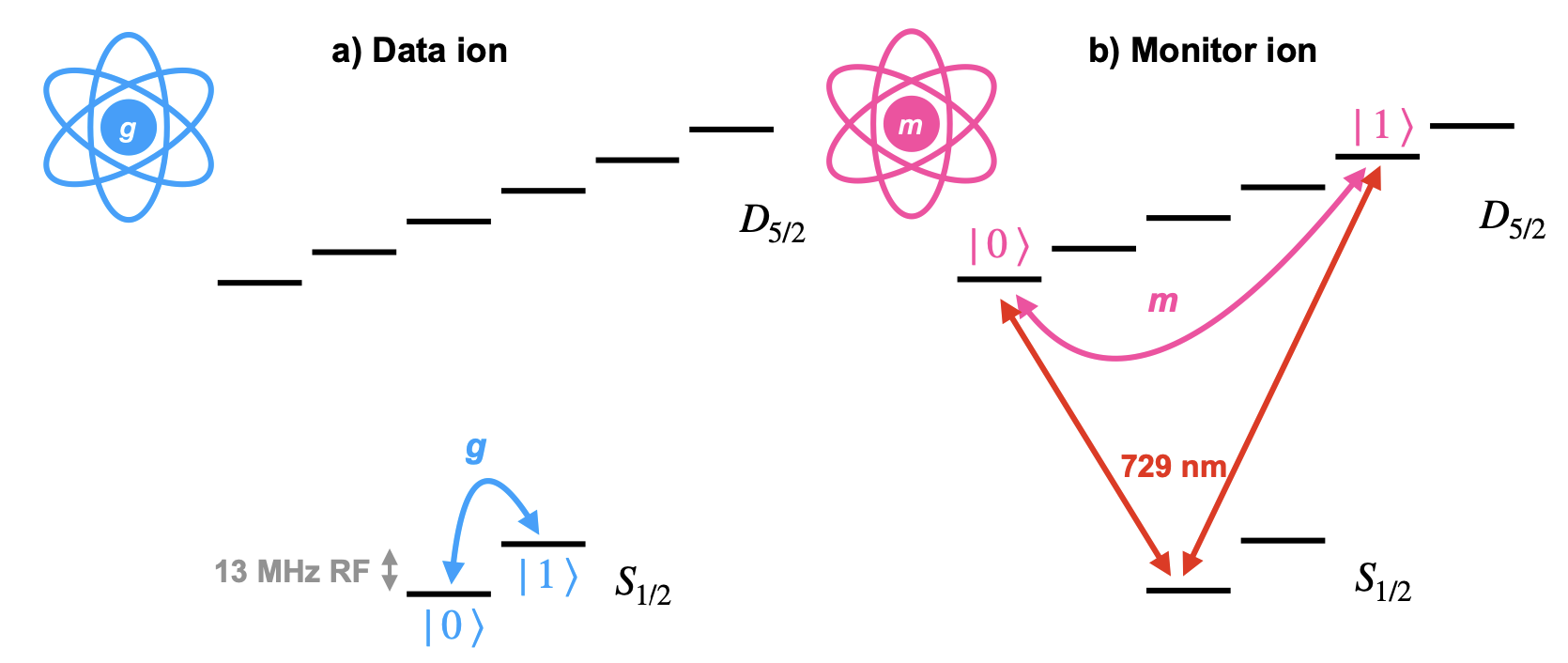
We demonstrate a trapped-ion protocol in which a dedicated "monitor" qubit tracks magnetic-field drifts in real time without interrupting data-qubit operations. Using two 40Ca+ ions and the optical–metastable–ground architecture, we encode the data qubit in the ground-state manifold and the monitor qubit in a metastable-state manifold to achieve spectral separation. The monitor qubit senses magnetic fluctuations during data-qubit experiments, enabling feedforward corrections. Under applied 1/f2 magnetic noise, the protocol maintains coherence, extends usable probe times by up to √2 compared with interleaved calibration, and doubles experimental throughput. These results establish monitor qubits as a scalable tool for real-time recalibration in quantum processors.
Quantum channel discrimination using quantum signal processing
DeBry, Sinanan-Singh, Bruzewicz, Reens, Kim, Roychowdhury, McConnell, Chuang, Chiaverini
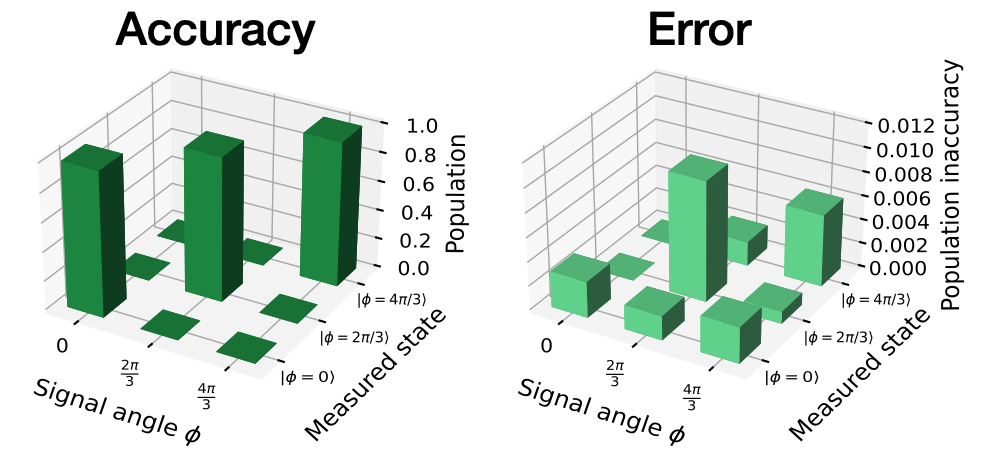
We demonstrate accurate, single-shot discrimination among three quantum channels using a single trapped 40Ca+ ion. Leveraging the six-level D5/2 metastable manifold and quantum signal processing (QSP), we implement trapped-ion analogues of phase-shift-keying (PSK) and amplitude-shift-keying (ASK) protocols and achieve >99% discrimination accuracy—limited only by characterized experimental imperfections. The protocol scales to larger channel sets with finite queries and highlights the utility of metastable qudit states for advanced quantum communication and sensing tasks.